What is unavailable?
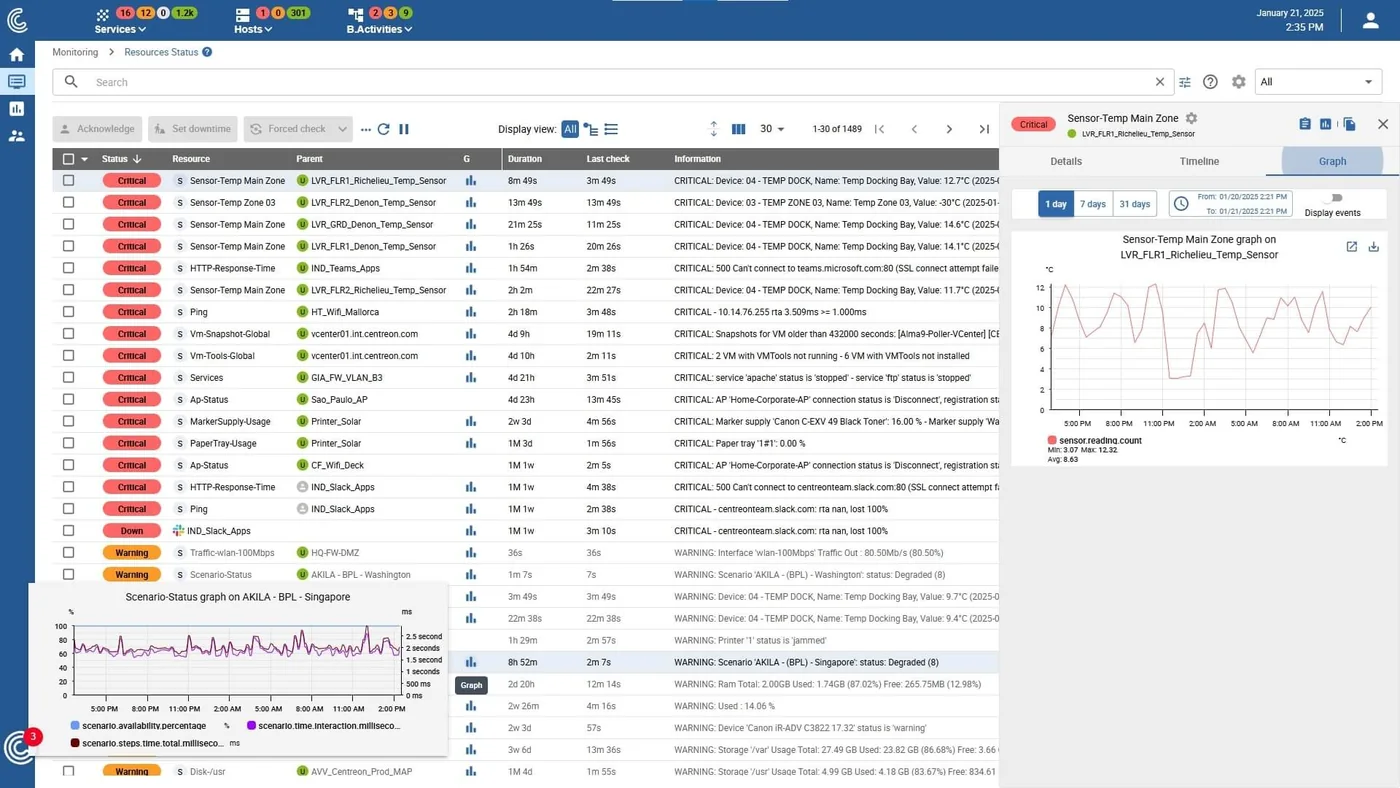
The status of hosts, services, and key indicators provides a clear starting point for investigation.
CENTREON · INFRASTRUCTURE MONITORING
POKO ITS helps organisations assess, design, and implement Centreon monitoring around real operational risk. Networks, servers, databases, applications, cloud, and edge resources gain a shared view, priorities, and a path to response.

WHY CENTREON
Monitoring creates value when the team understands what is at risk, who responds, and what the impact is. Centreon supports a unified view across complex cloud, on-premise, and edge environments, with distributed architecture and a broad monitoring connector catalogue. We align priorities, dashboards, and thresholds with real operations.
Networks, servers, applications, databases, cloud, and edge.
Service availability alongside component status.
Integration and extensions matched to the environment.
From focused systems to complex environments.
WHAT GOOD MONITORING SHOULD ANSWER
An operational view should help the team understand what is affected, how long the issue has lasted, which dependencies exist, and who should respond.
The status of hosts, services, and key indicators provides a clear starting point for investigation.
Components are grouped into business views so infrastructure is connected to the services it supports.
Performance and event history helps distinguish a current fault from a recurring or capacity issue.
Notifications, integrations, and operating rules connect the signal with the team and process that should respond.
OUR ENGAGEMENT
Systems, dependencies, existing alerts, and operational risk.
Architecture, pollers, thresholds, priorities, and dashboards.
Configuration, integrations, testing, and operational documentation.
Noise reduction, view refinement, and response improvement.
NO-OBLIGATION CONVERSATION
Describe the objective and current state. We will explain what is worth checking and what a realistic first step could look like.